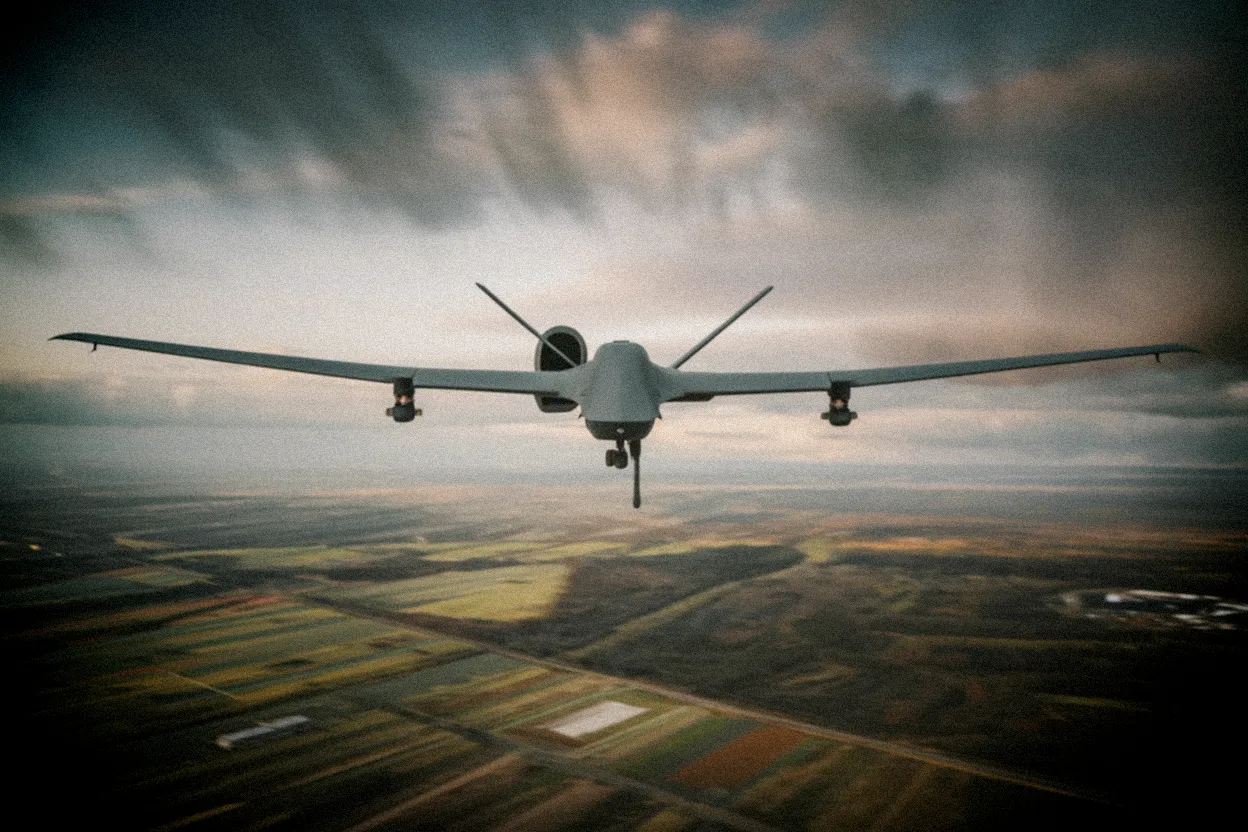
French defense electronics giant Thales and automaker Renault are teaming up to mass-produce a new “kamikaze” drone called Toutatis, targeting output of 1,000 units per month starting in 2027.
The partnership pairs two very different industrial cultures: Thales, a major player in defense electronics, and Renault, whose factories are built for high-speed, high-volume production. That manufacturing muscle is exactly what Thales is tapping as France tries to solve a problem that has loomed since the start of the war in Ukraine—how to build military hardware fast, and in large numbers.
Toutatis is described as a remotely operated munition—what militaries commonly call a kamikaze drone. It is designed to crash into its target and does not return. The system is presented as offensive, not intended for reconnaissance or intelligence gathering, but for striking targets.
Renault’s factory know-how, repurposed for defense production
Renault’s role is not accidental. The auto industry has decades of experience producing complex electronic and mechanical systems at scale, under tight cost and delivery constraints—pressures that traditional defense manufacturing has not always absorbed in the same way. A kamikaze drone of this type can share several components, structurally, with automotive equipment, including motors, batteries, sensors, and electronic boards.
The production goal is explicit: reach 1,000 units per month starting in 2027, according to L’Usine Nouvelle and Le Monde. That would represent a major shift from the typical pace of France’s defense sector, which has historically been geared toward multi-year programs with relatively low volumes rather than mass production.
The war in Ukraine has shaped the thinking behind the push. Since 2022, the conflict has shown how drone quantity can matter as much as the individual quality of systems. Ukrainian forces have relied on volume to saturate Russian defenses, a lesson that has pushed Western manufacturers to rethink production models.
What Toutatis would do in combat remains unclear
Even as the industrial plan comes into focus, the exact operational role of Toutatis in a conflict has not been publicly detailed by the two groups. The drone is presented as offensive, but available sources do not specify whether it is meant for close support of ground forces, saturation strikes against air defenses, or attacks aimed at logistics.
That ambiguity may be deliberate. In the market for remotely operated munitions, versatility is often a selling point as well as a tactical reality. Still, France’s military would need to define how it intends to use such systems before large production volumes translate into real operational capability.
The strategic context is pushing France to move quickly. France has acknowledged a lag in military drones compared with several partners, and debate has intensified since the start of the war in Ukraine over the resilience of the country’s defense industrial base. The Thales-Renault deal is positioned as a direct response to that criticism.
Industrial sovereignty is central—and the timeline is tight
Beyond the Toutatis drone itself, the partnership reflects a broader trend in France: the defense industry is trying to widen its production base by bringing in nontraditional industrial players. Renault is not a defense supplier, and that is both an argument in favor of the approach and a risk.
It is an argument because automotive production capacity can be mobilized at scale without the delays that would come with building a brand-new dedicated line. It is a risk because military certification, supply security constraints, and traceability requirements add layers of complexity that the auto sector does not typically manage.
The 2027 schedule leaves little room to resolve those issues. If production starts at the announced pace, France would, in theory, be able to build a stock of Toutatis drones capable of sustaining a prolonged engagement. If timelines slip, the project could end up as more of an industrial signal than a usable capability.