
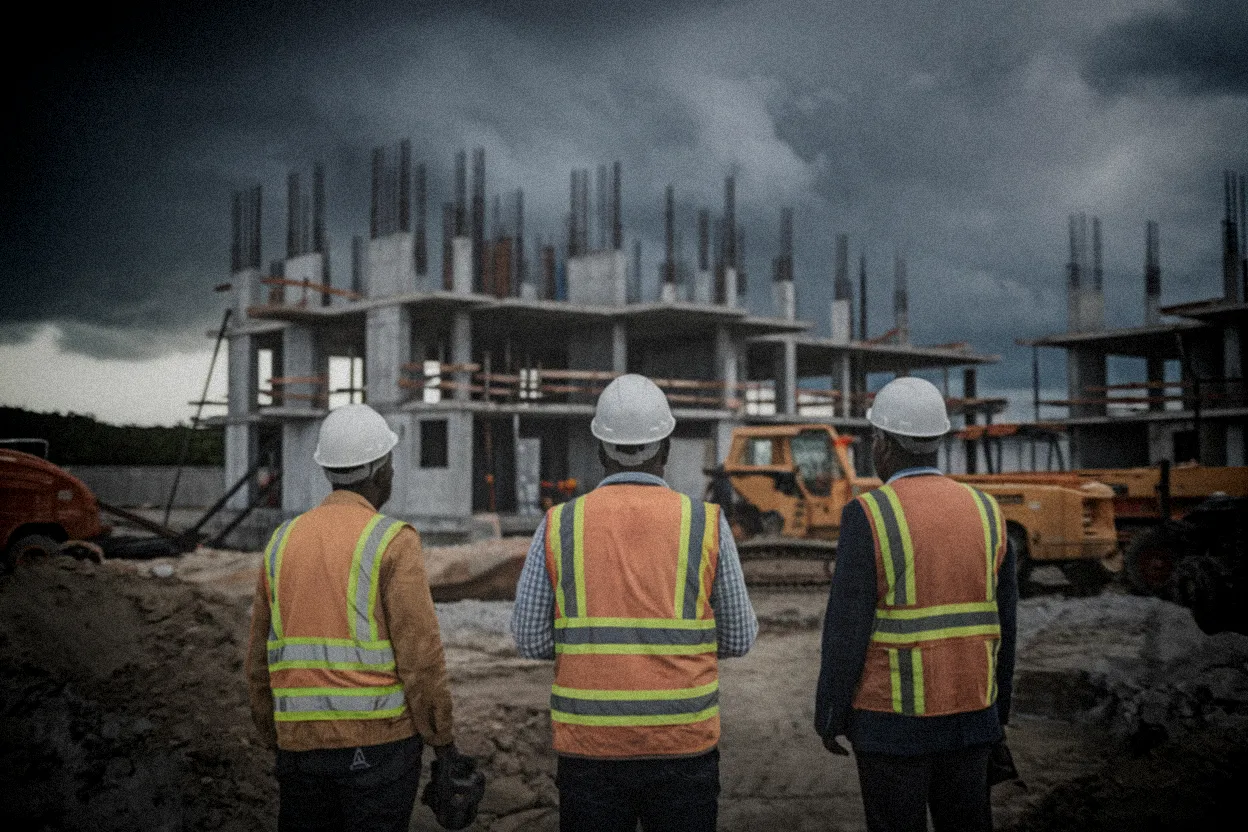
Business organizations in Guadeloupe sounded what they called a “maximum alert” Wednesday, warning the French Caribbean territory’s construction and public works sector is on the brink of collapse.
Meeting in Pointe-à-Pitre under the banner of Guadeloupe Économique—a coalition that includes employer groups and local chambers—industry representatives described a crisis they say is unprecedented on the island: stalled job sites, companies squeezed by late payments, shortages of materials, and rising costs.
The message, they said, was a “last” appeal to public authorities to act quickly, arguing that without an immediate response the fallout could hit jobs and the broader Guadeloupe economy for years.
A downturn that industry leaders trace back to 2022
The current emergency did not come out of nowhere, according to the Institut d’émission des départements d’outre-mer (IEDOM), a public institution that tracks economic conditions in France’s overseas departments and territories.
IEDOM says Guadeloupe’s construction sector has been going through a difficult adjustment after several years of declining public-sector orders, a pullback observed since 2022. In its annual economic and financial report published June 16, IEDOM paints a mixed picture for 2025: some parts of the economy show signs of stabilization, but construction remains one of the persistent weak spots.
Tourism continues to play its role as an engine of growth, and private investment remains at a high level, the report says. But those brighter signals have not offset the building sector’s structural problems. Companies also struggle to hire, with the skills they need still hard to find in the local labor market, according to the same report.
The social backdrop is also worsening. In 2025, Guadeloupe recorded 817 over-indebtedness filings—up 23.4% from the previous year—an indicator, IEDOM says, of growing household fragility in an already tense economic environment.
| Indicateur | Donnée |
|---|---|
| Dossiers de surendettement enregistrés | 817 |
| Variation sur un an | +23,4 % |
| Variation demandeurs d’emploi catégorie A | -1,4 % sur un an |
| Recul de la commande publique BTP observé depuis | 2022 |
Source : France-Antilles / IEDOM
“Local preference” in public contracts becomes the central demand
Beyond the alarm, construction leaders are pushing a specific remedy: priority access for Guadeloupe-based companies to local public procurement.
The argument is both economic and social. In Guadeloupe, construction and public works is a major source of employment and a pillar of the local economy, the groups said.
The debate over “local preference” in public tenders is not new. It was raised politically before, including in a written question sent in April 2020 to France’s economy minister, Bruno Le Maire. Six years later, industry professionals say little has fundamentally changed—and that what they describe as an unregulated opening of public contracts to outside firms is further weakening a sector already under heavy strain.
In Pointe-à-Pitre on Wednesday, the warning was blunt: without emergency measures from public authorities, a significant share of Guadeloupe’s productive base could disappear.
Jobs market shows resilience, but construction remains a pressure point
IEDOM says Guadeloupe’s labor market has held up overall. The number of Category A job seekers—people registered as unemployed with no work—fell 1.4% year over year, and private-sector employment remained at a high level.
But that topline picture masks sharp sector-by-sector stress. Construction is one of the areas where hiring difficulties remain pronounced—not because there are no applicants, but because companies say they cannot find qualified profiles that match their needs.
For Guadeloupe Économique’s representatives, the immediate priorities are practical: unblock pending payments, restart halted projects, and secure guarantees on access to local public contracts. Those steps, they argue, are necessary to prevent a collapse that could leave lasting damage across the island’s economy.

