
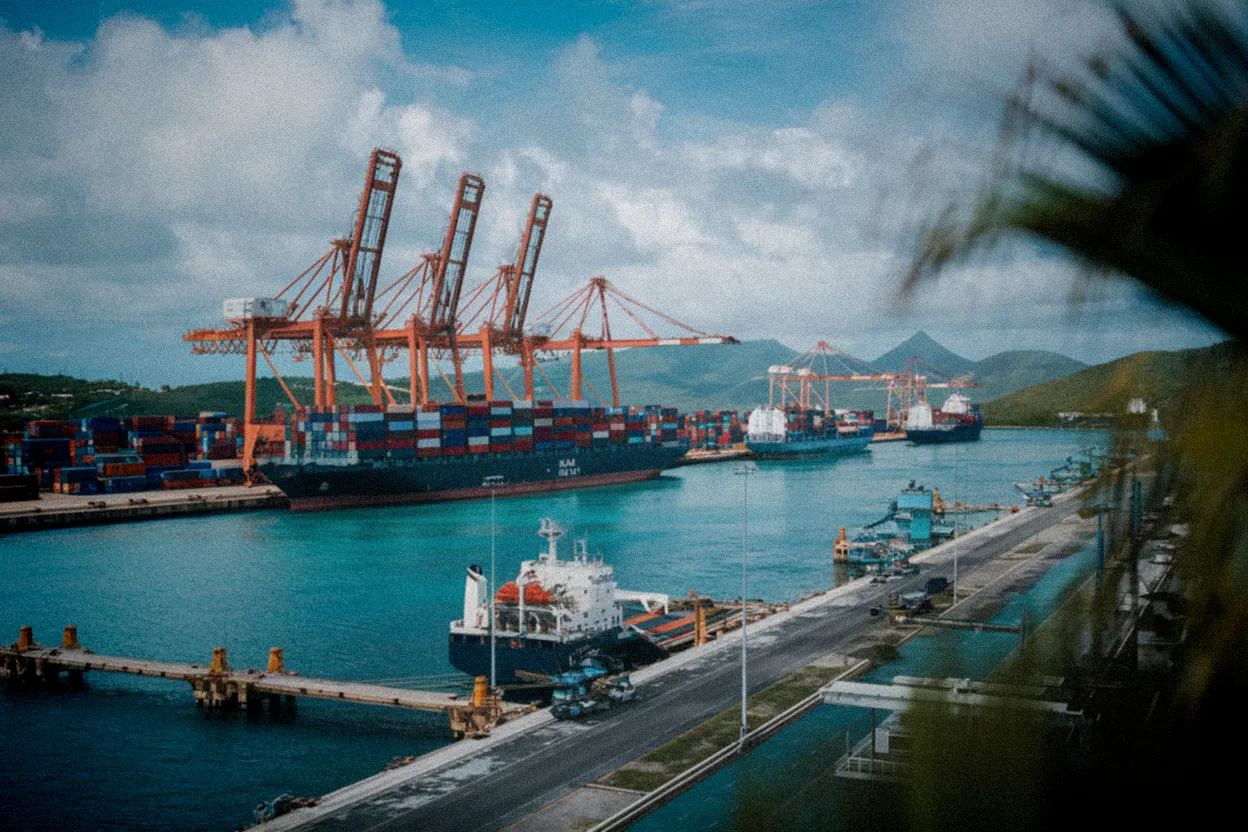
The ports of Martinique and Guadeloupe want to establish themselves as regional transshipment hubs. Drug trafficking is now part of the equation.
The pitch is straightforward: turn France’s Caribbean islands into a freight crossroads for the wider region, leveraging their location between transatlantic shipping lanes and Latin American markets. But an investigation published by Les Echos says those big port ambitions are now drawing the attention of drug-trafficking networks operating across the Caribbean.
Martinique and Guadeloupe share what the report describes as a structural vulnerability: they sit at the interface between Europe and maritime routes that carry large volumes of cocaine from South America. Expanding port capacity, the logic goes, also expands the surface area for attempted criminal infiltration.
C-Hub Antilles Guyane, the organization behind the hub push
A dedicated company has been created to carry the hub strategy: C-HUB ANTILLES GUYANE, registered under the trade name C-HUB. Formed on April 2, 2025, as a simplified joint-stock company (SAS), it is based at 574 chemin Pays Mêlé in Le Lamentin, Martinique. Its president is Valérie Platon.
The entity is listed as active, according to official data from France’s INSEE (the national statistics agency) and INPI (the intellectual property office) available on the French government’s open-data portal, data.gouv.fr.
Its recent creation highlights how backers are trying to formalize the hub project institutionally—at the same moment port-security concerns are intensifying in the French Caribbean.
Strategic ports, growing exposure
The Caribbean has for several years been one of the main transit zones for cocaine headed to Europe. The French Antilles’ ports—French-law infrastructure in the middle of that maritime space—are monitored chokepoints, but difficult to control completely.
And the very goal of the “Hub Antilles” plan—handling more cargo—would also make the job harder for customs and law enforcement, the report notes.
Investigations into other European ports, with Antwerp often cited as a leading example, have shown how criminal organizations adapt as hubs scale up: corrupting staff, hiding drugs in legitimate containers, and multiplying falsified manifests. Les Echos frames the central question bluntly: has the French Caribbean port buildout integrated that security constraint from the start?
So far, the article says, port authorities and the French state have not provided a detailed public answer on what security measures are planned to accompany the expansion in capacity.
Narcotrafficking and port development in the French Antilles


A double-edged bet for the islands’ economies
For Martinique and Guadeloupe, the stakes go beyond logistics. Becoming a regional hub is presented as a way to attract higher-value flows and skilled jobs in cargo handling, logistics, and services for shipping companies. It is also framed as a way to reduce dependence on direct connections with mainland France and plug more deeply into Caribbean supply chains.
But the reputational risk is real, the report argues. If port infrastructure becomes linked to repeated drug seizures or corruption scandals, the hub strategy could backfire on its promoters. Investors and international shipping companies are particularly sensitive to governance and security in the ports they use.
Les Echos’ investigation lands in the middle of that tension between economic ambition and security imperatives. C-Hub Antilles Guyane—led by Valérie Platon from Le Lamentin—will have to show the two can coexist.
Hub Antilles: what to know about the port project
- C-Hub Antilles Guyane (C-Hub) was created on April 2, 2025, with headquarters in Le Lamentin, Martinique.
- The SAS is led by president Valérie Platon.
- The ports of Martinique and Guadeloupe are being targeted by drug-trafficking networks, according to Les Echos.
- The Caribbean is a major transit zone for cocaine headed to Europe.
- No public security plan has yet been detailed by port authorities.
Sources
5 sources · 5 sourced facts

