
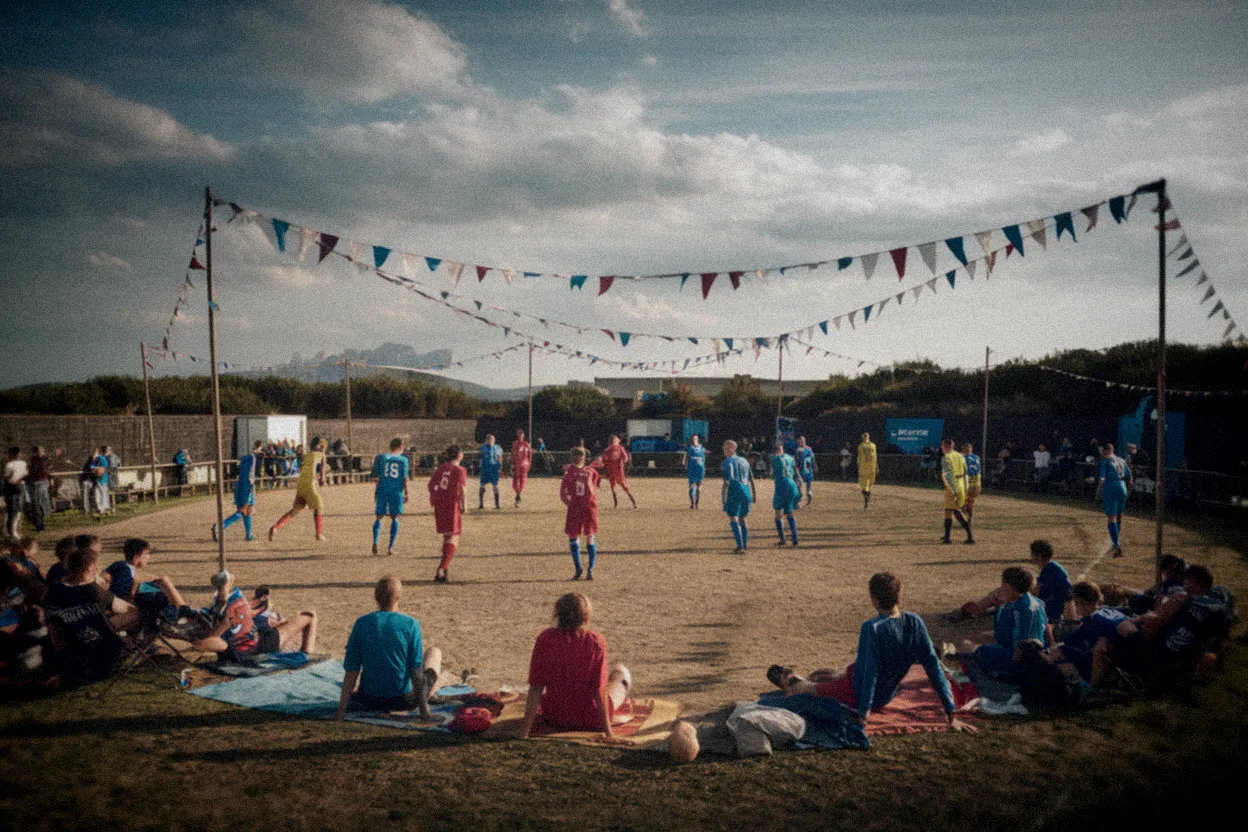
Every year on France’s Cap Corse peninsula, a small-scale soccer tournament called Biera è Ballò brings residents together for competition on the field and a village-style celebration off it—far from the professional sports circuit.
More than a set of matches, the event is built around community: the stands matter as much as the pitch. In a corner of Corsica where villages quiet down in winter and come back to life in summer, organizers frame the tournament as a concrete part of local collective life.
The name says it all. “Biera è Ballò” means “beer and dance” in the Corsican language—signaling that the point is to play, but also to reconnect.
A tournament rooted in Cap Corse’s local identity
Cap Corse is often described as a wind-battered rocky promontory, but it also cultivates its own homegrown sporting traditions. Biera è Ballò is presented as a human-scale event that puts soccer at the center—without letting it stand alone.
The tournament is described as part of a broader social fabric, where the gathering is as important as the result. In summer, when seasonal visitors return and villages fill up again, events like this become a focal point for community life.
Soccer, then a party: the event’s two-sided formula
The tournament’s format pairs games with moments designed for sharing and celebration. Its Corsican name—“beer and dance”—reflects the atmosphere: people come to compete, but also to see one another.
That dual purpose is what separates it from purely competitive amateur tournaments. The stated goal is to bring together locals and passersby around a shared project, using soccer as the excuse and conviviality as the endgame.
Why it’s bigger than amateur soccer
Organizers and local coverage frame Biera è Ballò as a rallying point for Cap Corse villages, especially during the busy summer season. The event is also described as deeply tied to its rural setting, where local sports initiatives help maintain social bonds outside major federations.
For Corsicans living off the island, the tournament is portrayed as an identity marker—one of those summer dates that can prompt a return home, or at least a sense of pride from afar. And in a region without a professional club, tournaments like this are presented as a way to keep amateur soccer alive in rural areas where village clubs can be fragile outside tourist season.
Cap Corse initiatives beyond the big federations
The article also points to a separate sign of local structuring: a company named CAP CORSE, with its headquarters registered in Saint-Jean-les-Deux-Jumeaux, created on July 8, 2019, according to official data from INSEE and INPI (France’s national statistics institute and intellectual property registry). The company is led by manager Franck Lucien Florent Plu, and its status is listed as active.
While that legal entity simply shares the territory’s name, it is presented as evidence of a wider dynamic—local actors organizing initiatives rooted in their own communities, outside the biggest institutional frameworks.
A summer touchstone for Corsicans living elsewhere
For Corsicans based on the French mainland or abroad, summer tournaments like Biera è Ballò are often described as a chance to reconnect with the peninsula during a trip back. Cap Corse’s summer calendar includes multiple gatherings of this kind, and Biera è Ballò is cited as one of them, with growing visibility through local relays such as Stampa Paese.
From a distance, the Corsican diaspora follows these events through social media or regional press. In that sense, the tournament is depicted as more than an amateur competition: it becomes a reason to return, or simply a cultural marker that travels beyond the island.
Amateur Corsican soccer, sustained by tradition and local energy
Cap Corse does not have a professional club, but the article describes a dense network of soccer associations. Summer tournaments like Biera è Ballò help keep the sport active in rural areas, where village clubs can struggle outside the tourist season.
In that landscape, Biera è Ballò is positioned as a date where the final score isn’t the only thing that matters—whether you’re a player, a spectator, or just passing through the peninsula.

