
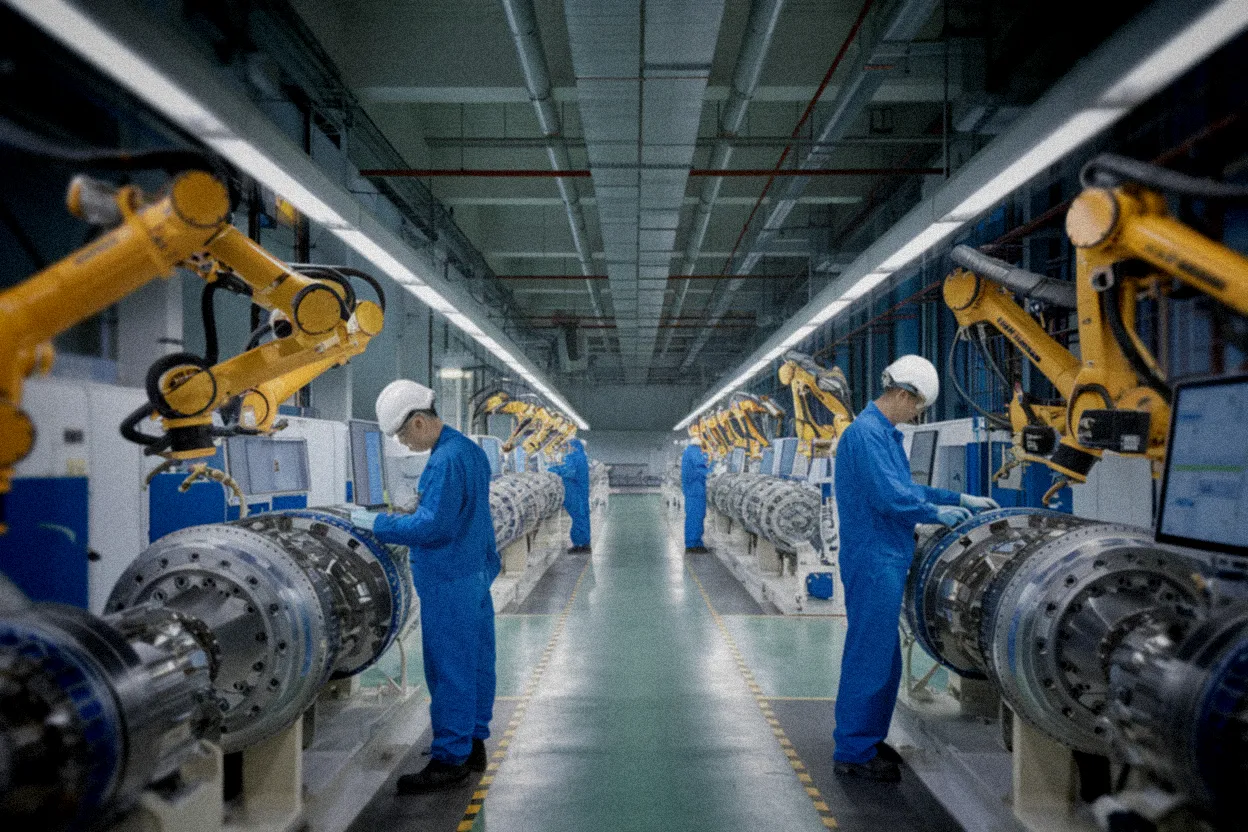
Framatome is investing €103 million (about $111 million) at its Jeumont site in northern France to bring auto-industry-style production pacing and sequencing to the manufacturing of critical parts for France’s next-generation EPR2 nuclear reactors.
The move is the latest in a series of upgrades after investments already launched at Le Creusot and Saint-Marcel. Jeumont becomes the third link in Framatome’s planned industrial ramp-up aimed at sustaining a build rate equivalent to 1.5 EPR reactors per year.
The goal isn’t just higher output. Framatome is trying to change how France’s nuclear supply chain works—shifting away from one-off, long-cycle fabrication toward a more repeatable, tightly sequenced model more commonly associated with automotive manufacturing. Two critical EPR2 components are targeted by the overhaul.
Jeumont becomes the third upgraded site in Framatome’s EPR2 chain
Jeumont’s industrial roots run deep. Before it became part of Framatome’s orbit, the plant operated under the Jeumont-Schneider name, a well-known brand in heavy electromechanics in northern France. That legacy matters, because it helps explain why precision mechanical know-how is concentrated in the area—skills Framatome now wants to reorganize for the EPR2 push.
With €103 million (about $111 million) committed, the project covers production tools, factory flows, and the underlying manufacturing logic. The central idea is to apply the automotive industry’s principles of pace and repeatability to nuclear components—achieving industrial volumes without giving up quality. At this scale, the approach is unusual in the nuclear sector.
Auto-style sequencing, applied to reactor hardware
In vehicle manufacturing, each operation on an assembly line is timed, scheduled, and repeated the same way thousands of times. Parts arrive at the right station at the right moment, and quality checks are built into the flow rather than bolted on at the end. That kind of end-to-end sequencing has not been applied to the production of reactor-core components, the article says.
Nuclear manufacturing comes with its own constraints: full traceability, safety standards unlike those in other industries, and parts whose dimensions and tolerances allow no approximation. Adapting automotive methods to that environment is exactly what Framatome calls a “small cultural revolution for nuclear.”
The target pace—delivering enough equipment to support construction of 1.5 EPR reactors a year—shows what’s at stake. France has launched a program for a first batch of six EPR2 reactors, with options to go beyond that. Without sufficient industrial capacity, the schedule can’t hold.
Pourquoi la sérialisation nucléaire est un pari industriel inédit


What the €103 million investment covers
| Site | Localisation | Rôle dans la chaîne EPR2 |
|---|---|---|
| Le Creusot | Bourgogne-Franche-Comté | Forge et pièces lourdes |
| Saint-Marcel | Bourgogne-Franche-Comté | Chaudronnerie nucléaire |
| Jeumont | Hauts-de-France | Équipements critiques, production sérialisée (103 M€) |
Source : L’Usine Nouvelle
The €103 million (about $111 million) budget is intended to modernize workshops, buy new equipment, and reorganize manufacturing flows. Two critical EPR2 pieces sit at the center of the plan. Framatome has not publicly specified which ones, but the article notes that new-generation reactors rely on components such as primary pump hardware, steam generators, and instrumentation-and-control systems—areas where scaling up to serial production has been identified for years as a major industrial bottleneck.
A French nuclear supply chain trying to catch up
The EPR2 program has highlighted a structural weakness in France’s nuclear industry: production capacity didn’t keep pace with nuclear power’s political comeback. During lean years—roughly between 2012 and 2022—investment in industrial tools slowed, the article says. Restarting lines, training qualified welders, and rebuilding engineering offices takes time.
Jeumont Electric, a separate entity from Framatome but based in the same area, pointed to the same momentum in 2025 in a Le Figaro article dated July 25, 2025. The industrial fabric of northern France is repositioning around the needs of the nuclear program, in a cluster-like dynamic.
Meanwhile, Framatome’s global competitors in reactor-component manufacturing—U.S.-based Westinghouse, South Korea’s KEPCO, and China’s CNNC—kept investing more continuously. The gap in production maturity is real, even if French know-how remains widely recognized for its quality, the article says.
Can nuclear manufacturing really be industrialized like auto production?
The automotive comparison has limits. A car is assembled from roughly 20,000 to 30,000 parts on rhythms measured in minutes. An EPR2 is a one-off megaproject built over 10 to 15 years, with each component subject to qualification and independent inspection processes that don’t have a true equivalent in mass manufacturing.
What Framatome is trying to transfer is the spirit of lean manufacturing—not second-by-second line speed, but cutting dead time, standardizing tasks, and integrating traceability into the process rather than adding it after the fact. On parts with long production cycles, even a 15% to 20% improvement can translate into several weeks saved per reactor.
To hit the 1.5-reactors-per-year target, Framatome can’t afford for Jeumont to become the weak link. The €103 million (about $111 million) investment is first a response to schedule pressure—and only then an attempt at industrial reinvention.
Framatome Jeumont : les chiffres clés de l'investissement EPR2
- Framatome investit 103 millions d'euros sur son site de Jeumont (Nord) pour les EPR2.
- L'objectif est d'atteindre une cadence de production équivalant à 1,5 EPR par an.
- Deux équipements critiques des EPR2 sont ciblés par cette transformation industrielle.
- Jeumont est le troisième site transformé après Le Creusot et Saint-Marcel.
- Le principe directeur : séquencer la production nucléaire comme dans l'industrie automobile.
Sources
3 sources · 3 faits sourcés

