
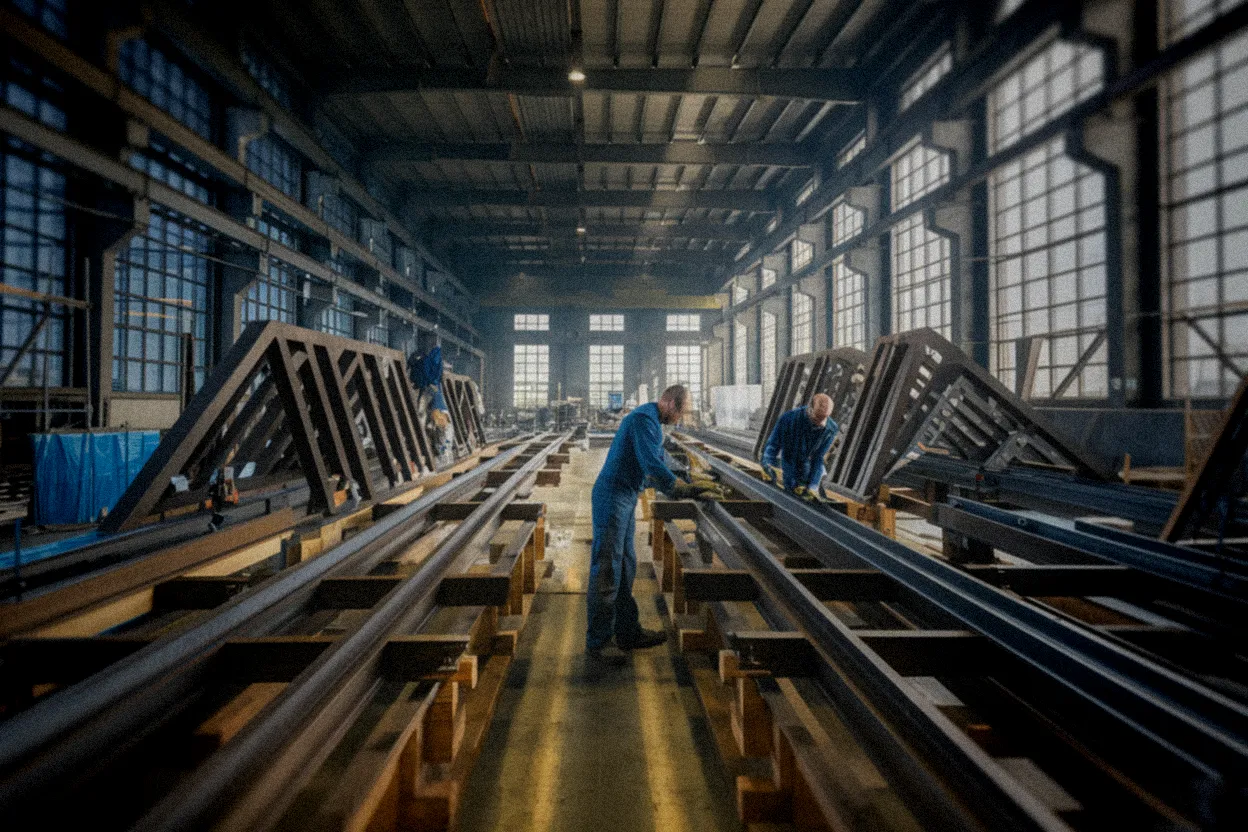
In the small town of Noyal-Muzillac in France’s Morbihan department, Briand Métal Bretagne is carving out a specific lane in a region better known for smaller-scale metalwork: building factories and industrial facilities with steel frames that also incorporate timber as a structural material.
The strategy puts the company in the market for large industrial contracts tied to factory expansions and reindustrialization projects—work that goes beyond the locksmithing, precision turning, or surface-treatment activities often associated with Brittany’s metal sector.
A regional metal industry with many specialties—and a niche for full-frame assembly
Brittany has a dense network of metal-industry sites spread across its four departments. In Morbihan alone, industrial establishments span activities including metal treatment and coating, manufacturing metal doors and windows, and industrial mechanics.
Briand Métal Bretagne is listed under the activity code for “assembly work for metal structures” (4399B), placing it in a distinct category: companies equipped to assemble complete building frames, not just parts or components.
Pairing steel with timber in industrial construction reflects growing demand for hybrid solutions that remain robust while being less carbon-intensive than all-concrete or all-metal designs. For a regionally sized company, competing in that space requires both dual technical expertise and the capacity to respond to bids for large-scale job sites.
Metallurgy’s quiet role in Brittany’s industrial economy
Industry accounts for 12% of Brittany’s GDP, according to Jacques Pidoux, a Brittany-based business leader quoted by Le Télégramme. In the region, metallurgy sits alongside plastics, chemicals, and the wood sector—forming a productive base that can be less visible than food processing but still central to local employment.
Noyal-Muzillac fits that pattern. Briand Métal Bretagne’s presence in a rural Morbihan community reflects Brittany’s dispersed industrial fabric, where specialized firms occupy technical niches far from major industrial zones.
If order books follow, the company’s pivot toward steel-and-timber factory construction could strengthen the industrial footprint of an area that is betting on a diverse mix of know-how.

