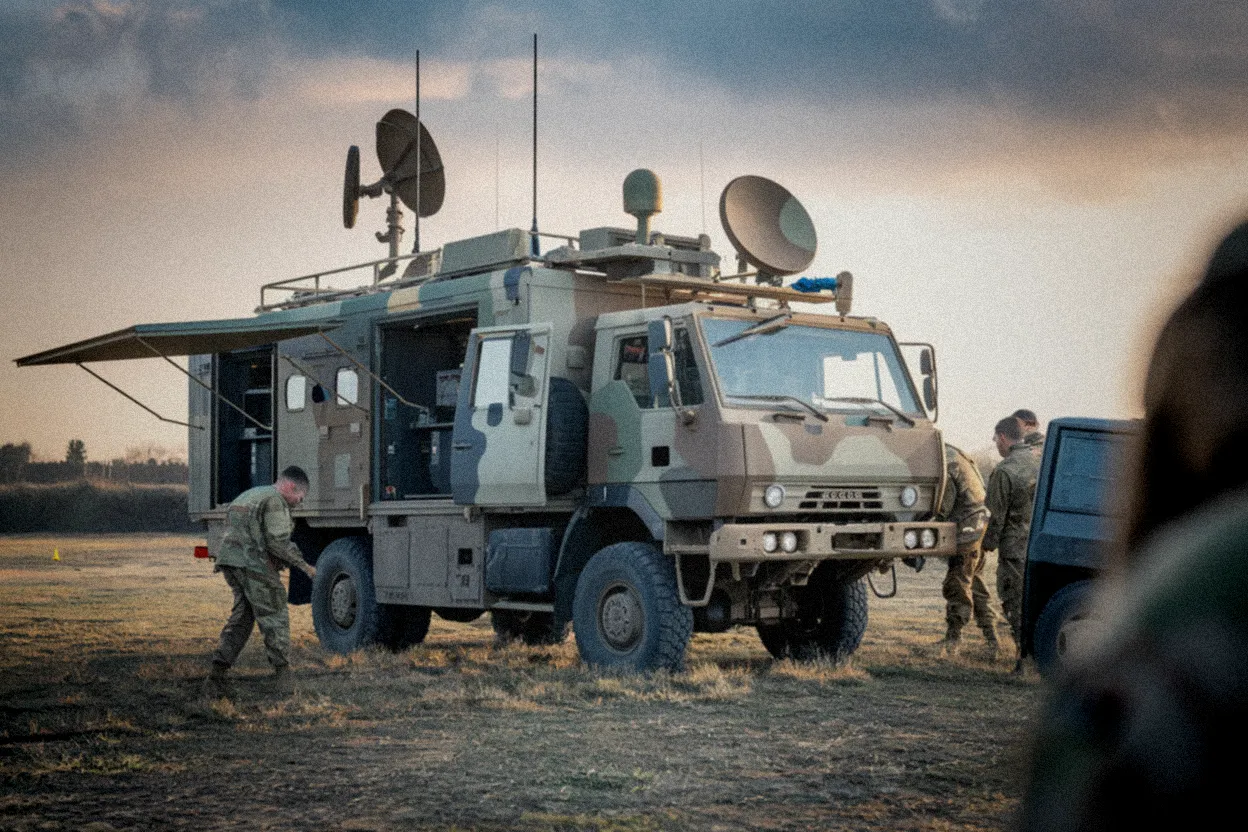
Renault and French defense electronics giant Thales have unveiled the 4Troop, a tactical 4×4 designed to serve as a mobile command post—built, the companies say, to keep costs down while baking secure communications and battlefield connectivity into the vehicle from the start.
The project was driven by a direct request from France’s defense procurement agency, the Direction générale de l’armement (DGA), which concluded that many current command-post vehicles are expensive, awkward to use, and often look like improvised setups—assorted gear bolted into standard vehicles rather than purpose-built systems.
Ombeline Suzanne, director of special projects and partnerships at Renault Group, described the problem in comments reported by Le Parisien: “Some current command posts, costly and not very ergonomic, sometimes have a very artisanal feel, with various instruments gathered as best they can in cars. The 4Troop project natively integrates the Thales system into the vehicle’s electronic architecture, enabling secure communications, tactical connectivity and operational coordination.”
A division of labor: Renault builds at scale, Thales supplies the secure tech
The pitch behind 4Troop is straightforward: Renault brings industrial production know-how, while Thales brings the onboard defense technology. In a joint statement, the two groups said: “This project brings Renault’s technological and industrial expertise and Thales’ cutting-edge onboard technology in secure communications and connectivity in order to develop a new generation of multi-mission vehicles, combining speed of production, durability and economic optimization.”[4]
That split matters because Renault is not a traditional defense prime contractor. The value it claims to add is the kind of high-volume manufacturing discipline that dedicated arms makers can struggle to deliver on their own—producing quickly, controlling per-unit costs, and meeting deadlines. That, the article notes, is also why the DGA has turned to Renault on other programs.
Renault’s defense push accelerates as France prioritizes a “war economy”
4Troop is part of a broader ramp-up in Renault’s military work since France elevated “war economy” production—rapid, scalable defense manufacturing—to a national priority. According to the article, Renault initially hesitated when the DGA approached it about producing large numbers of remotely operated munitions, and set a condition: assurances that the effort would not compromise “its investment capacity in its core business.”
After receiving that assurance, Renault signed with Turgis Gaillard to produce the long-range attack drone Chorus at the Ampère plant in Cléon, in the Seine-Maritime department of northern France.
Renault and Thales have also announced a second program: Toutatis, described as a remotely operated munition designed to resist jamming, with an interchangeable warhead. Renault Group CEO François Provost presented the project in Villepinte in June 2026 at Eurosatory, one of Europe’s major defense trade shows. The stated goal, he said, is to build “a sovereign, agile and competitive drone sector, fully meeting the challenges of the war economy.” Production could begin as soon as 2027, with a target rate of 1,000 units per month in the first year, according to the partners.[5]
Pourquoi le 4Troop change l'approche des postes de commandement


How 4Troop is positioned against existing command vehicles
In the mobile command-post niche, the incumbents are typically vehicles derived from dedicated military platforms—often heavier, more expensive to build, and more costly to maintain. Renault and Thales are betting that starting with a Renault base and integrating Thales systems “natively” will yield a package that is cheaper to buy, easier to service, and faster to deliver.
Secure communications and tactical connectivity sit at the center of the requirement. The article points to the war in Ukraine as a recent demonstration of how critical real-time coordination can be between dispersed units—making a command vehicle designed around those functions as much a shift in approach as a shift in hardware.
The key question, the article argues, is durability: whether a platform rooted in civilian automotive engineering can meet the demands of military field use. European militaries often require levels of protection and ruggedness that generalist automakers do not always match compared with specialist armored-vehicle manufacturers.
Toutatis and 4Troop: different products, the same industrial bet
Together, the two programs reflect a shared strategy: pair French defense technology with the industrial capacity of a major automaker to cut costs and increase production tempo. Thales supplies the system; Renault supplies the volume—an explicit response to recurring criticism about the speed and cost of France’s defense industrial base, according to the article.[1]
For Renault, the move is also strategic. By entering war-economy production without abandoning its civilian car business, the group is seeking to diversify revenue in a difficult automotive environment while aligning with Paris’ push for industrial sovereignty. Chorus production in Cléon, the potential 4Troop line, and the prospect of 1,000 Toutatis units per month starting in 2027 would mark an unusual posture for a mass-market automaker.
Eurosatory 2026 spotlights France’s push to tap civilian factories for defense output
Eurosatory in Villepinte served as the stage for multiple announcements reflecting the same direction: France’s defense sector is looking to mobilize civilian production capacity rather than waiting for traditional arms makers alone to ramp up. Renault and Thales are a prominent example of that hybrid model.
The 4Troop, presented on June 15, 2026, is described as the most concrete expression of that approach so far in the tactical-vehicle segment. The next hurdle will be persuading military leadership that cost control has not come at the expense of operational performance—an assessment the 4Troop will have to pass before any firm order.
4Troop et Toutatis : chiffres clés du partenariat Renault-Thales
- Le 4Troop intègre nativement le système Thales dans l'architecture électronique du véhicule.
- La DGA a directement sollicité Renault pour développer une version poste de commandement à coût maîtrisé.
- Renault produit également le drone Chorus à l'usine Ampère de Cléon avec Turgis Gaillard.
- Le drone Toutatis, co-développé avec Thales, vise une cadence de 1 000 unités par mois dès 2027.
- François Provost a présenté Toutatis au salon Eurosatory à Villepinte en juin 2026.
Sources
3 sources · 3 faits sourcés