
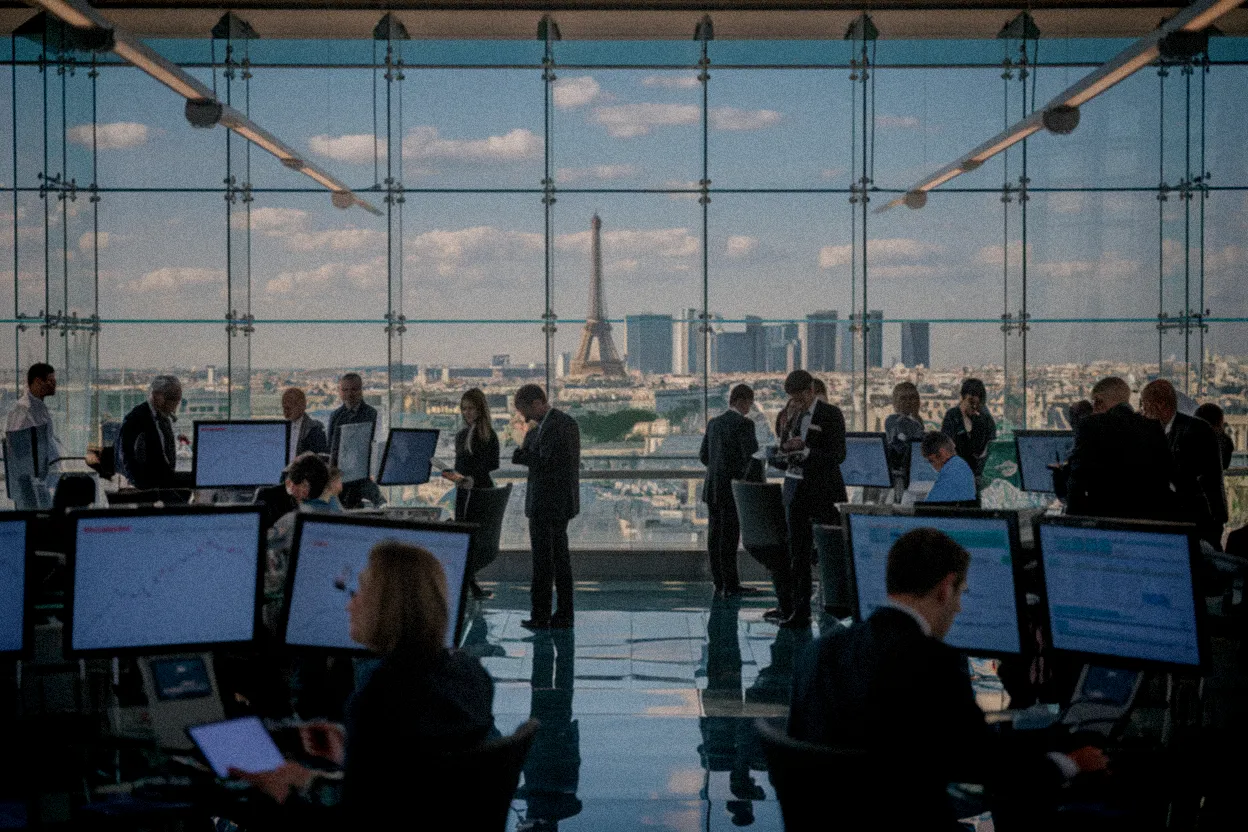
France’s biggest listed companies are seeing a slow but consequential reshuffling of power: founding families are gradually giving up ground in CAC 40 shareholdings as international investment funds take a larger role.
Bernard Arnault remains the most visible face of France’s family capitalism. As chairman of luxury giant LVMH, he controls a group whose name alone appeared 124 times in Les Echos over the span of a few months—without even counting mentions of brands in its portfolio such as Dior, Louis Vuitton, Guerlain and Moët. The sheer frequency signals how central the company has become to France’s economy.
But even this concentrated family model has shown strain. In January 2025, LVMH profits fell 17%, at the same moment Arnault was promising, according to Le Monde, a “wind of optimism” coming from the United States. Against the backdrop of the dissolution of France’s National Assembly and broader government instability, CAC 40 CEOs have rarely voiced such open concern about French taxes and regulation.
Another major—far more discreet—example of family capitalism is the Mulliez family. Behind retailers including Auchan, Leroy Merlin, Decathlon, Kiabi and Boulanger sits a single control structure: roughly 130 brands or chains, about 700,000 employees worldwide, and combined annual revenue near €100 billion (about $108 billion). The empire has long been managed with intense secrecy—so much so that Le Monde described it as a model built on “the art of secrecy.”
LVMH’s media ownership and the conflict-of-interest debate
LVMH’s 2007 purchase of Les Echos—one of France’s leading business newspapers—became a flashpoint over the concentration of ownership in French economic media. Journalists at the paper went on strike for two days, denouncing what they called “a serious threat to editorial independence” and, more broadly, to “the credibility of economic information in France.”
The protest highlighted a wider trend: major French news outlets increasingly controlled by a small number of industrial groups. Le Figaro belonged to Dassault; La Tribune was already in LVMH’s orbit; Lagardère presented itself as a reference shareholder of Le Monde, which itself was linked to EADS via Airbus. As Les Echos journalists put it bluntly at the time: “The LVMH group could use the daily newspaper as an instrument of influence.”
What was once framed as an anomaly now reads as a structural feature of CAC 40 capitalism: porous boundaries between industrial, media and financial interests—often inside families or conglomerates seeking to protect influence well beyond their core businesses.
Eiffage shows how institutional investors are reshaping the CAC 40
Eiffage’s entry into the CAC 40 illustrates a different direction: the rise of companies with dispersed ownership, where no single family holds control. The construction and concessions group reported €689 million (about $744 million) in net profit for 2025, proposed a €4.80 dividend per share (about $5.18)—up from €4.70—and posted an order book rising to €29.9 billion (about $32.3 billion) at the end of 2025.
| Indicateur | Valeur |
|---|---|
| Bénéfice net 2025 | 689 M€ |
| Dividende proposé 2026 (par action) | 4,80 € |
| Dividende 2025 (par action) | 4,70 € |
| Free cash-flow 2025 | 2,1 Md€ |
| Carnet de commandes fin 2025 | 29,9 Md€ (+3 %) |
| Dette financière nette | En baisse de 0,9 Md€ |
Source : Les Echos / Eiffage, résultats annuels 2025
In public companies without a dominant family shareholder, institutional funds—often American or British—tend to carry the most weight. That changes governance: more emphasis on quarterly returns, tighter pressure on margins, and constant tradeoffs between investment and payouts.
Pourquoi les familles françaises reculent dans le CAC 40


Is the retreat of French dynasties structural—or just a cycle?
France’s big families aren’t disappearing from the CAC 40. Arnault still maintains firm control over LVMH. The Mulliez family remains unlisted but continues to weigh heavily on French consumer life. Other industrial dynasties still hold significant stakes across major companies.
What’s changing is the overall balance of power. International investment funds increase their share almost automatically with each capital raise, each difficult succession, and each opening to the market. CAC 40 CEOs said it plainly in January 2025: French taxation, growing regulation and political instability are strengthening the temptation to seek capital elsewhere.
France’s CAC 40 companies logged billions of euros in profits and dividends in a record year, according to data cited by the CGT, one of France’s major labor unions. But who benefits from those dividends? Increasingly, funds headquartered outside Paris—turning “shareholder sovereignty” into a live political and economic question rather than an abstract one.
Eiffage expects slower activity growth in 2026 than in 2025, while projecting an improvement in operating income and net profit. At its April 22, 2026 annual general meeting, shareholders voted on the renewal and election of three independent directors. It’s a snapshot of a more “post-family” CAC 40: formalized governance, dispersed ownership, and institutional investors in the driver’s seat.
CAC 40 et actionnariat : les chiffres à retenir
- Les profits de LVMH ont reculé de 17 % en 2025, selon Le Monde.
- L'empire Mulliez regroupe quelque 130 marques et emploie environ 700 000 personnes dans le monde.
- Eiffage a dégagé un bénéfice net de 689 millions d'euros en 2025 et rejoint le CAC 40.
- En 2007, les journalistes des Echos ont fait grève deux jours contre le rachat par LVMH.
- Le carnet de commandes d'Eiffage atteignait 29,9 milliards d'euros fin 2025, en hausse de 3 %.
Sources
4 sources · 4 faits sourcés

