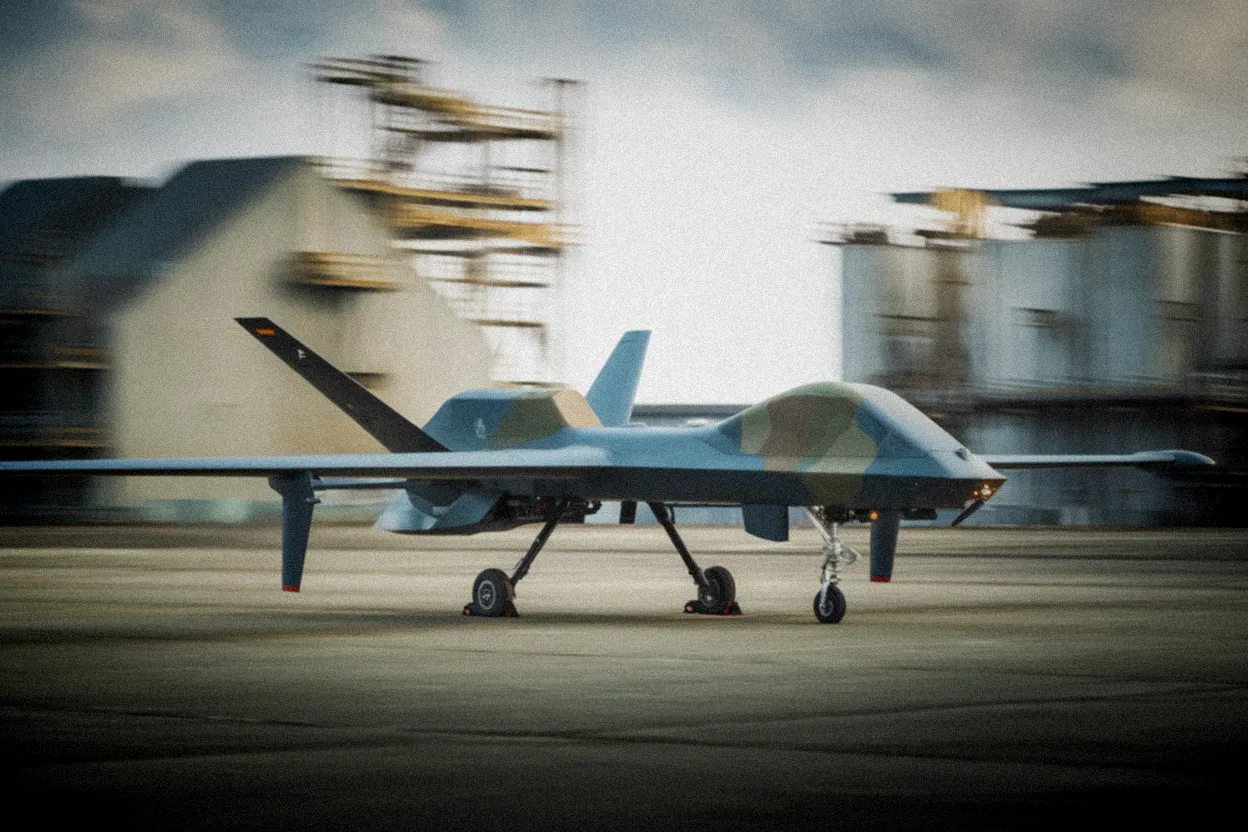
Renault and French defense contractor Thales announced June 16, 2026, that they’ve struck a deal to mass-produce a remotely operated loitering munition called Toutatis—targeting output of 1,000 units a month starting in 2027.
The companies unveiled the agreement at Eurosatory, a major defense trade show outside Paris. They said production is set to begin operationally in late 2026, then ramp up to the 2027 monthly goal.
The partnership pairs a major automaker with one of Europe’s largest defense groups, as France pushes to scale up domestic drone manufacturing capacity.
A short-range loitering munition built for high-intensity combat
Toutatis is described as a short-range loitering munition with an operating range of about 6 to 19 miles (10 to 30 kilometers), designed for “high-intensity” conflicts. It can be operated by a single soldier and deployed from a combat vehicle, an aircraft, or a naval platform.
Its warhead is interchangeable depending on the mission, allowing it to neutralize armored vehicles or carry out intelligence missions. The system is designed to operate in swarms and to resist electromagnetic jamming. The stated flight endurance is 30 minutes.
To reach the planned production tempo, Renault and Thales said they reworked the drone’s architecture. La Tribune reported the redesign cut the number of parts by 30% to 40%, including by using plastic injection molding.
The stated aim is a low-cost munition competitive with Ukrainian production and with Iran’s Shahed drones, which the article says have set standards in recent conflicts.
Renault’s drone push expands after earlier Chorus project
The Thales deal fits into a broader Renault strategy in military drones. In January 2026, Renault announced an alliance with Turgis Gaillard, a French small and mid-size company with 400 employees and about €80 million (about $86 million) in revenue, to develop a long-range remotely operated munition.
That plan called for a joint venture named Chorus, to be created under the auspices of France’s Direction générale de l’armement (DGA), the government’s defense procurement agency. L’Usine Nouvelle reported the first contract had an initial value of €35 million (about $38 million) and could represent up to €1 billion (about $1.08 billion) in revenue for Renault over 10 years.
Renault, headquartered in Boulogne-Billancourt outside Paris, said at the time it had been approached by the French Armed Forces Ministry to apply its industrial expertise—particularly in design, industrialization, and high-volume production—to help build a French drone sector. The target then was 600 units per month.
With Toutatis and Thales, the monthly target rises to 1,000. The companies said the first markets they are aiming for are international, with priority given to Eastern Europe.
Sources
Les Echos; Investir (Les Echos); La Tribune