
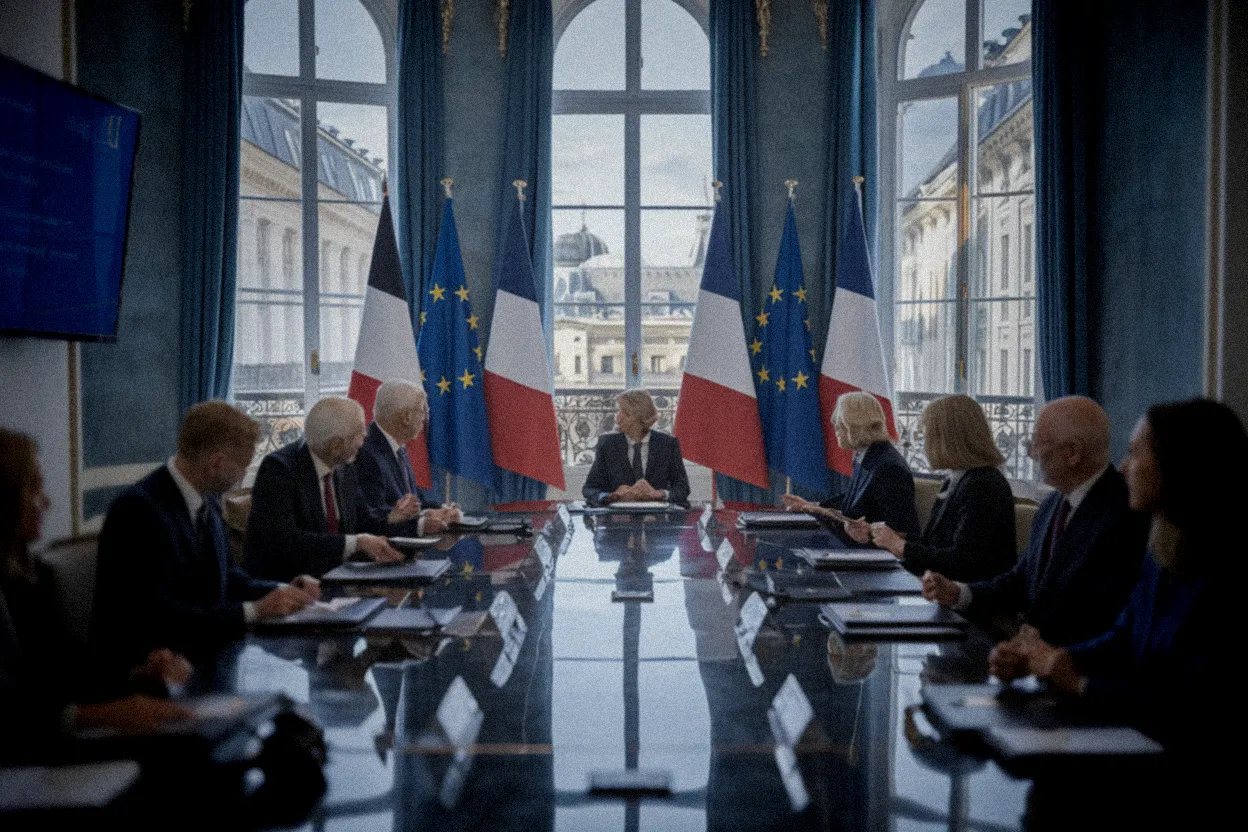
A proposal moving through the European Parliament would hand the European Commission new authority over arms export licenses—power that has traditionally sat with national governments and is especially sensitive for France, one of the world’s biggest weapons exporters.
The change, tucked into a European Parliament report published December 22, targets the EU’s rules on intra-bloc transfers of defense products. If adopted, the amendment would empower the Commission to certify new military production sites and issue export licenses on behalf of all 27 member states—meaning Paris would no longer be the sole decision-maker on who can buy French-made Rafale fighter jets, missiles, or frigates.
The report frames the shift as a security imperative: “The security situation requires the coherent establishment of approval and certification procedures regulated at the level of the European Union for new production facilities and export licenses for defense products.” French officials and analysts, however, see a familiar Brussels push returning in a new form after an earlier attempt was blocked.
A fight that resurfaced after France blocked an earlier attempt
This is not the first time the issue has flared in Brussels. In September 2025, the Mars group warned about a European Commission “defense omnibus package,” arguing one component aimed to “gradually” seize “the sovereign prerogatives of states in export control.” France blocked that effort.
Now, the European Parliament has revived the idea through its own legislative vehicle, sidestepping French opposition previously expressed in the Council—where member states negotiate EU laws.
In an op-ed published by La Tribune, the mechanism is described in detail: using delegated acts enabled by the revised directive, the Commission could define which equipment counts as “sensitive,” decide which licenses to grant or deny, and determine when exemptions apply. The potential outcome, critics argue, is that French arms exports could be approved against Paris’ diplomatic interests—or, conversely, contracts could be blocked by Brussels even if they are “indispensable” to the economic balance of a program.
Bruno Alomar, a former senior official at the European Commission, was blunt in Le Figaro. Facing the amendment, he wrote, “the European Union is not afraid to expose itself to the most unimaginable response: France” as the designated adversary. He also pointed to what he described as earlier Brussels incursions into core state powers, citing the 2003 working time directive, which he said still applies—“against all legal reason”—to the French armed forces.
France’s export clout—and why Paris says it has too much to lose
The economic stakes are high. Over the past five years, France has held its position as the world’s second-largest arms exporter, behind only the United States. In France, export control is exercised directly by the executive branch and is closely tied to foreign policy and national industrial interests.
Handing that authority to the Commission would, in this view, shift strategic decisions to an institution not accountable to French voters, with outcomes shaped by compromises among 27 countries whose interests often diverge.
La Tribune warned the measure would mechanically trigger an “economic war between European companies in the defense sector,” weakening firms most exposed internationally, with the “more or less explicit complicity of companies from third countries or foreign states that will consolidate their interests.” The argument: while European manufacturers jockey for licenses in Brussels, U.S., Russian, or Chinese competitors could fill the order books left open.
Several observers cited in the sources say France’s domestic political crisis—consuming the attention of the Lecornu government as it navigates budget tradeoffs—has created an opening for proponents to advance the file quietly. La Tribune described the approach as a “slow train and salami” strategy: move in small slices, using each bout of instability to capture powers not предусмотрed by the Lisbon Treaty.
A long legislative road—but a shifting balance of power
Paris has not lost the fight yet. The proposed change to Directive 2009/81/EC is not final. After the European Parliament’s position, the Council—member states themselves—must adopt its own stance, followed by negotiations between the two institutions.
France can still formally oppose the measure at that stage, and it is likely not alone: other member states that export military equipment share at least some of its reservations.
Still, La Tribune argued France “seems to be losing more and more of its battles in Brussels.” It pointed to domestic political weakness combined with a Commission pressing forward on defense despite what the outlet described as a lack of solid legal grounding in the treaties. The earlier “defense omnibus” episode—blocked once, then reintroduced via Parliament—illustrates how persistent the pressure has become.
For the Lecornu government, the Brussels fight would run alongside national budget negotiations, on a file where any retreat could directly affect France’s ability to finance its own weapons programs through exports.

