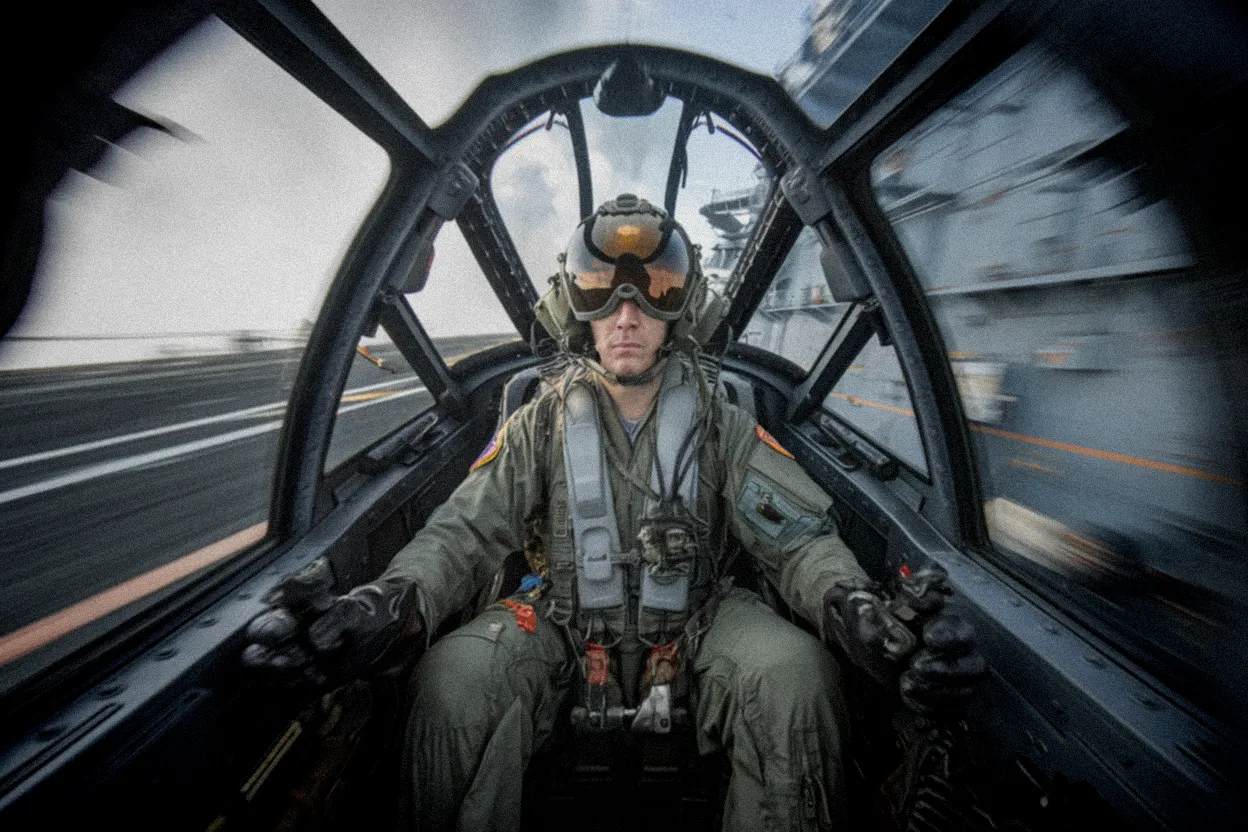
A catapult launch off France’s aircraft carrier Charles de Gaulle turns takeoff into a jolt of extreme acceleration—compressing a pilot’s world into a fraction of a second as a Rafale Marine fighter is hurled from zero to flying speed.
With only a few hundred meters of usable deck run, the launch isn’t a routine roll down a runway. It’s a brief but violent physical event that slams the aircraft—and the aviator strapped inside—forward with a force that training is designed to help them absorb.
As the catapult accelerates the jet over a very short distance, the pilot—cinched tight in the seat—first feels a shove backward as the system tensions up, then the G-forces hit at release. The head is pinned to the headrest, vision blurs slightly, and the body takes the удар before the aircraft tears free of the deck.
Charles de Gaulle is Europe’s only catapult-equipped aircraft carrier
The Charles de Gaulle remains the only non-U.S. aircraft carrier fitted with steam catapults. That technology imposes specific demands on carrier aircraft and crews, and the Rafale Marine is built to take it—reinforced structure, carrier-suited landing gear, and a catapult attachment integrated into the jet’s design.
France’s future next-generation aircraft carrier—whose construction is written into the country’s 2024–2030 military planning law—is expected to use electromagnetic catapults modeled on the U.S. Navy’s EMALS system. On the USS Gerald R. Ford, those catapults are 93 meters long—about 305 feet—each, replacing steam catapults after years of development work before being made reliable.
China is also pushing into electromagnetic catapult operations
France isn’t the only country aiming for the technology. China’s Fujian, a Type 003 aircraft carrier, has three electromagnetic catapults, compared with four on U.S. carriers. At 316 meters—about 1,037 feet—long and displacing more than 80,000 tons at full load, it is the world’s largest warship after U.S. Navy aircraft carriers.
Videos released in September showed catapult launches and arrested landings from its deck involving J-15 aircraft, J-35 stealth fighters, and KJ-600 airborne early warning planes. A handful of maneuvers doesn’t prove the system is fully reliable, but the footage marks a concrete step forward for China’s navy.
Rafale Marine launches in rough weather during Orion 26
The Charles de Gaulle recently carried out a string of catapult launches during the Orion 26 exercise, including in rain and wind—conditions that test both the ship’s systems and the people operating them. For pilots, each launch remains the same demanding sequence: a few seconds of maximum acceleration, and then the jet is airborne—alone.
Sources
Mer et Marine (3 sources; 7 sourced facts)