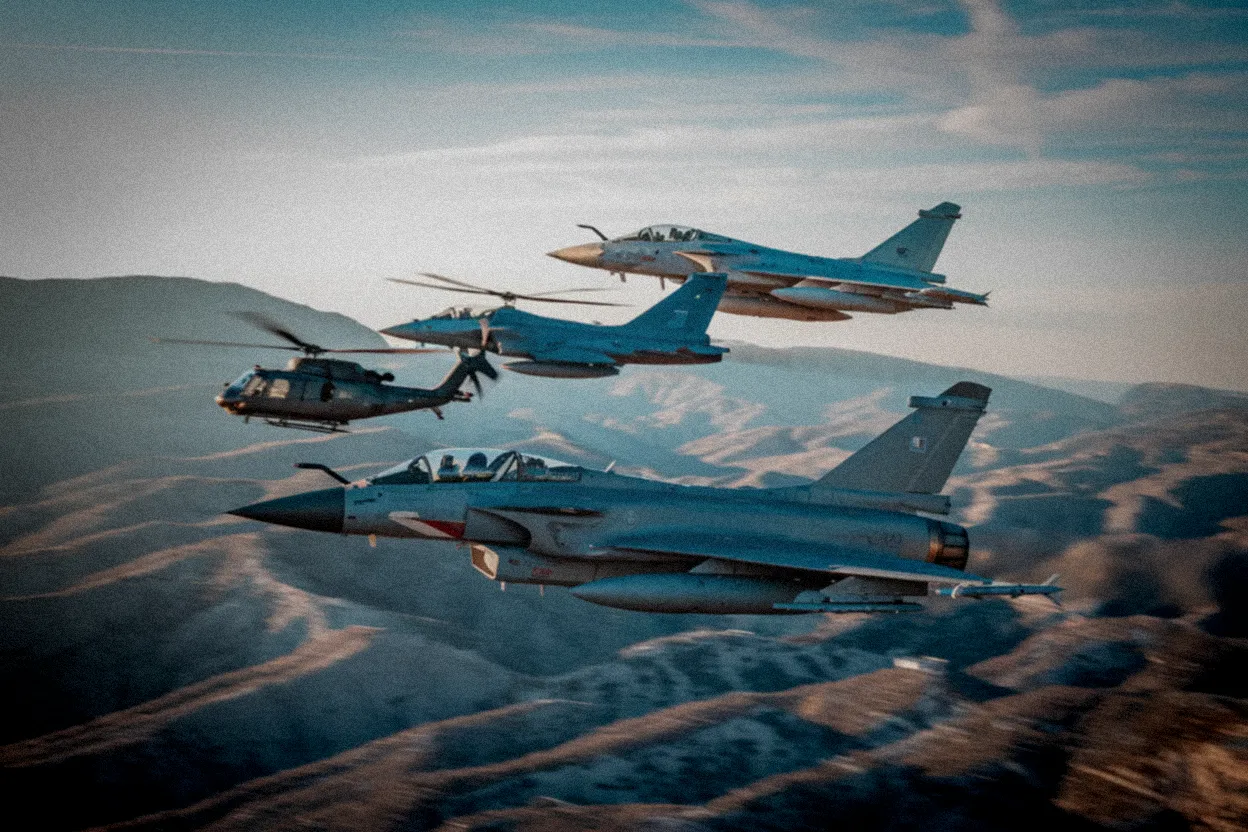
France’s Air and Space Force deployed Mirage 2000 fighter jets, Rafales and Fennec helicopters to protect the 2026 G7 summit, part of a broader security operation involving 16,000 personnel—while President Emmanuel Macron said France was “neither warned nor involved” in Israeli-American strikes on Iran.
The air-security posture for the G7 put three different aircraft types on station: the Mirage 2000, the Rafale and the Fennec helicopter. The mobilization came as French authorities rolled out an exceptional security footprint around the summit, with 16,000 people engaged overall.
The deployment also unfolded amid an unusually tense diplomatic and military moment. The Israeli-Iranian conflict dominated G7 discussions, and French officials moved to clarify Paris’ position for allies as French aircraft patrolled the summit’s airspace.
Macron: France was “neither warned nor involved” in Israeli-American operation against Iran
Macron said during a meeting of France’s Defense Council—a top-level national security decision-making body—that France had been “neither warned nor involved” in the Israeli-American operation against Iran. The statement explicitly set Paris apart from Washington and Tel Aviv on the issue, even as French aircraft were securing the airspace over the G7 summit.[5]
The wording was unambiguous: France did not take part in the strikes, and it was not informed in advance. The clarification drew a clear line between France’s role in protecting a major diplomatic event and its stance on the Middle East conflict.
Why France used a three-aircraft mix: Rafale, Mirage 2000 and Fennec
Flying the Mirage 2000, Rafale and Fennec at the same time highlighted how France layers different air capabilities. The Rafale handled air superiority and high-speed interception. The Mirage 2000 reinforced surveillance and patrol missions. The Fennec—a light attack and reconnaissance helicopter—covered low altitudes and close-in approaches.[1]
That kind of three-part deployment for a top-tier diplomatic event is not common. It reflected the threat assessment made by intelligence services and military leadership, in a regional environment strained by Middle East tensions and their potential spillover effects in Europe.
Ce que le déploiement aérien dit de la posture française


A show of air sovereignty—and a strategic message
French officials framed the decision to mobilize the three aircraft types as both operationally necessary and a demonstration of capability. The message: France can provide full air protection for an event of this scale on its own, without relying on outside support—signaling that capacity to allies at the G7 and to outside observers.
Macron’s assertion that France was not involved in the Israeli-American strikes on Iran, confirmed by the Élysée Palace, paired with the independent air-protection “bubble” over the summit, was presented as a coherent posture: France is sticking to its doctrine of strategic independence, even when its closest allies opt for direct military action.
G7 2026 : le dispositif aérien français en chiffres
- La France a déployé Mirage 2000, Rafale et hélicoptères Fennec pour sécuriser le sommet du G7.
- 16 000 personnes au total ont été mobilisées pour assurer la sécurité du sommet.
- Macron a affirmé que la France n'avait été ni prévenue ni impliquée dans les frappes israélo-américaines sur l'Iran.
- Le Conseil de défense a servi de cadre à la clarification officielle de la position française.
Sources
2 sources · 2 faits sourcés